Turn Your Datacenter into an AI Factory
Production LLM inference on your infrastructure — OpenAI-compatible APIs, optimized hardware, full data sovereignty.
The Challenge
From GPU Capacity to AI Revenue
Many datacenters have GPU capacity and growing demand. What's missing is a reliable way to turn that capacity into a sellable service with predictable performance and economics.
Revenue Gap
GPU capacity alone does not translate into revenue. Without the right serving stack and pricing model, utilization stays uneven and margins remain unclear.
Operational Complexity
Production workloads require low latency, high concurrency, and predictable behavior. Ad-hoc deployments and generic stacks struggle under real production traffic.
Loss of Control
Many providers sell access to their own infrastructure. Datacenters lose control over pricing, branding, and customer relationships.
CloudRift helps datacenter operators close this gap
By combining production software, benchmark-driven hardware guidance, and operational experience from running real datacenters at scale.
The Platform
Run Enterprise LLMs on Your Own GPUs
CloudRift enables organizations to offer production-grade LLM-as-a-service, running on their own hardware and delivered through enterprise-ready APIs.
Production LLM-as-a-Service
OpenAI-compatible APIs, streaming support, and usage-based billing — designed for real production workloads.
import openai

client = openai.OpenAI(
    api_key="YOUR_RIFT_API_KEY",
    base_url="https://inference.cloudrift.ai/v1"
)

completion = client.chat.completions.create(
    model="qwen/qwen3.5-35b-a3b",
    messages=[
        {"role": "user", "content": "Hello"}
    ],
    stream=True
)

for chunk in completion:
    print(chunk.choices[0].delta.content or "", end="")
Data-Driven Hardware Decisions
Real-world benchmarks and performance data guide GPU selection, configuration, and deployment strategy for your workloads.
Built by Experts
Designed and operated by teams with deep experience in model optimization, datacenter operations, and production inference at scale.
Process
How It Works
Step 1
Benchmark & Plan
Benchmark workloads across GPUs and configurations to define performance targets and hardware requirements.
Step 2
Deploy & Configure
Deploy a production stack optimized for throughput, latency, and concurrency with pre-built templates.
Step 3
Monitor & Optimize
Track performance metrics and fine-tune your infrastructure in real time.
Step 4
Scale on Demand
Deliver via OpenAI-compatible APIs with streaming and usage-based billing that scales with your workload.
Step 5
Collaborate & Share
Connect with trusted build partners for hardware procurement, financing, and benchmark-driven specifications.
Step 6
Iterate & Improve
Monitor performance, adjust configurations, and optimize cost and utilization over time.
Data-Driven
Benchmark-Driven Hardware Guidance
Inference performance depends heavily on hardware choice and configuration. CloudRift runs regular benchmarks across GPUs, models, and serving setups to understand real-world tradeoffs.
Why Our Benchmarks Matter
Synthetic specs do not reflect real production behavior. We measure complete serving paths under realistic load.
What We Benchmark
Models, GPU generations, throughput, latency, concurrency, cost efficiency, context lengths, parallelization parameters, and inference frameworks.
How Operators Use This Data
Operators use this data to choose hardware, tune deployments, and define pricing models for their inference services.
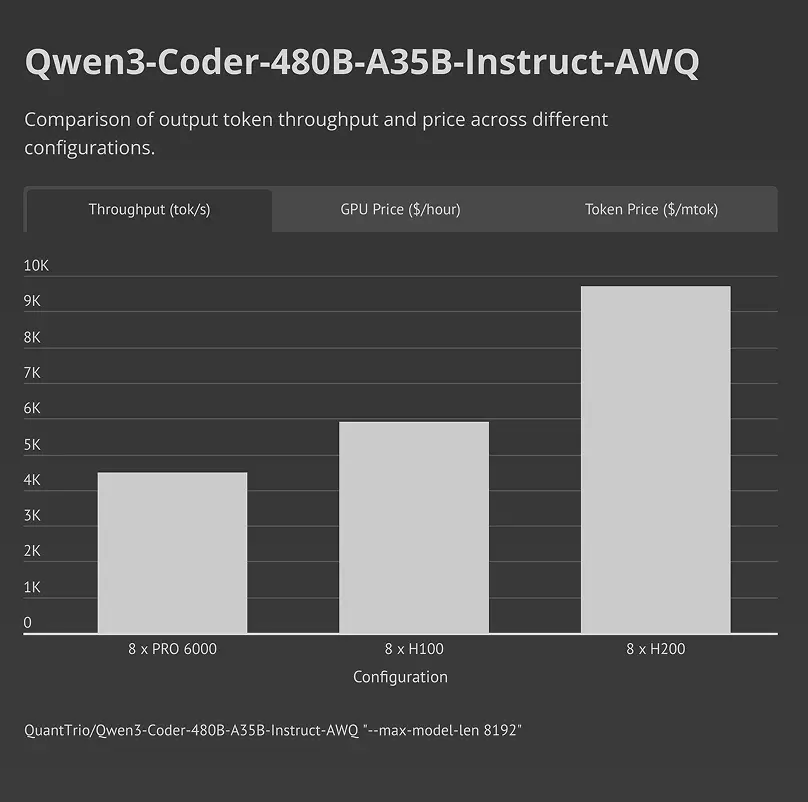
Real-world benchmark: Qwen3-Coder-480B-A35B-Instruct-AWQ tested on 8x RTX Pro 6000, 8x H100, and 8x H200 GPU configurations
Hardware
Inference Accelerators and Hardware Optimization
Some workloads require more than standard GPU configurations. CloudRift supports deeper hardware and system-level optimizations for demanding use cases.
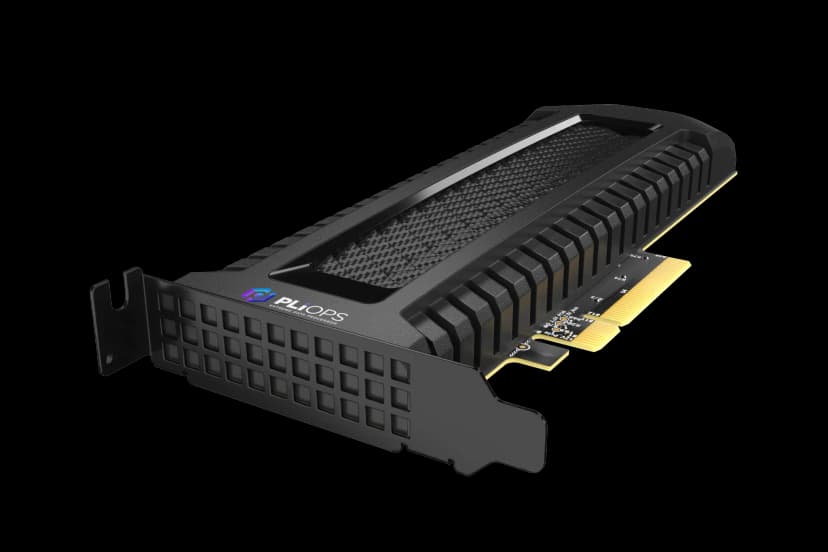
Accelerator Options
For select deployments, we support specialized accelerators designed to improve throughput and reduce latency by optimizing memory access and model serving paths.
- Faster KV cache access
- Reduced memory bottlenecks
- Better performance under high concurrency
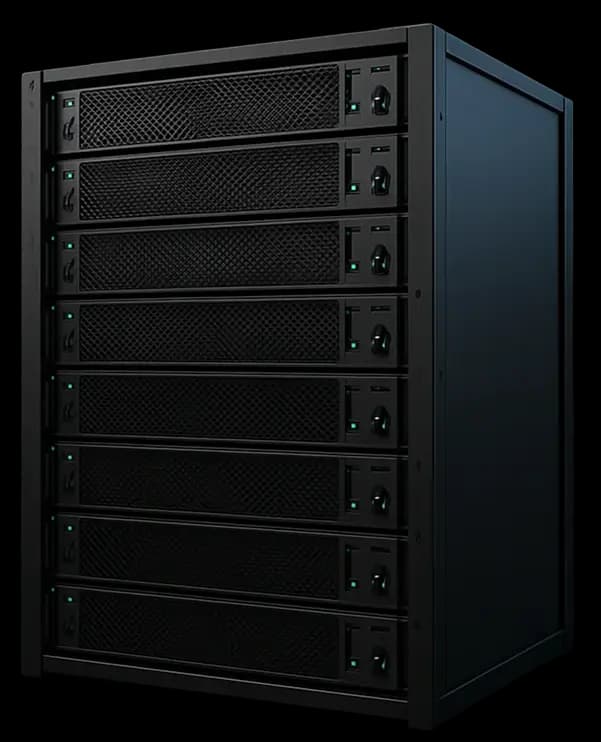
System and Rack-Level Optimization
Beyond individual components, CloudRift helps operators optimize their systems, including GPU density, storage layout, and network configuration.
- Hardware-aware serving configurations
- Balanced GPU, memory, and I/O
- Designs aligned with benchmark data
Use Cases
Enterprise Use Cases
CloudRift supports workloads with strict requirements around latency, throughput, and reliability.
Telecom and Network Services
Inference workloads supporting customer interaction, network optimization, and real-time decision systems. These use cases prioritize predictable latency and high concurrency across distributed environments.
Large-Scale AI Applications
Customer-facing AI systems such as chat interfaces, content generation, or search augmentation. These workloads demand throughput, reliability, and efficient scaling under peak traffic.
Banks and Financial Services
Workloads for fraud detection, customer service automation, document processing, and risk analysis. These use cases demand high reliability, data security, and regulatory compliance with predictable performance.
Internal Enterprise AI Systems
AI models used internally for automation, analytics, or support tooling, where reliability and data locality matter as much as performance.
Why CloudRift
Why Datacenter Operators Choose CloudRift
Infrastructure Ownership
Everything runs on your hardware, in your datacenters. You control capacity, deployment models, and physical constraints.
Customer & Pricing Control
You set pricing, billing models, and customer relationships. CloudRift does not sit between you and your customers.
Commercial Model
Designed for operators who want to offer AI as a service, not enterprises looking to consume someone else's cloud.
Operational Depth
CloudRift is built by teams who manage datacenters at scale. We design inference systems with operational realities in mind, not just API performance.
Hardware Flexibility
We support multiple GPU generations and configurations and help select hardware based on real benchmarks, not fixed product tiers.
Our Team
Years of Experience in Model Deployment & Optimization
Our team has deep expertise in production inference workloads, from deployment to optimization at scale.

Animoji
Real-time facial tracking

ARKit
Spatial computing

Hand Tracking
Vision Pro gestures

Portrait Mode
Depth sensing & bokeh

Roblox Face Tracking
Live avatar animation
.webp&w=3840&q=75)
Room Plan
3D space scanning

AI Texture Generation
Procedural asset creation

Hand Tracking
Gesture recognition
Ready to turn your datacenter into an AI factory?
Talk to our team about deploying production inference on your infrastructure.
FAQ
Common Questions About Inference
Contact Us
Let us know if you're looking to:
- Find an affordable GPU provider
- Sell your compute online
- Manage on-prem infrastructure
- Build a hybrid cloud solution
- Optimize your AI deployment
PO Box 1224, Santa Clara, CA 95052, USA
+1 (831) 534-3437
I'm interested in: